





Wise vs Revolut vs Monzo vs Bank Transfer: India to UK (2026 Tested)
 Ansar SkOctober 20, 20264 Mins read4
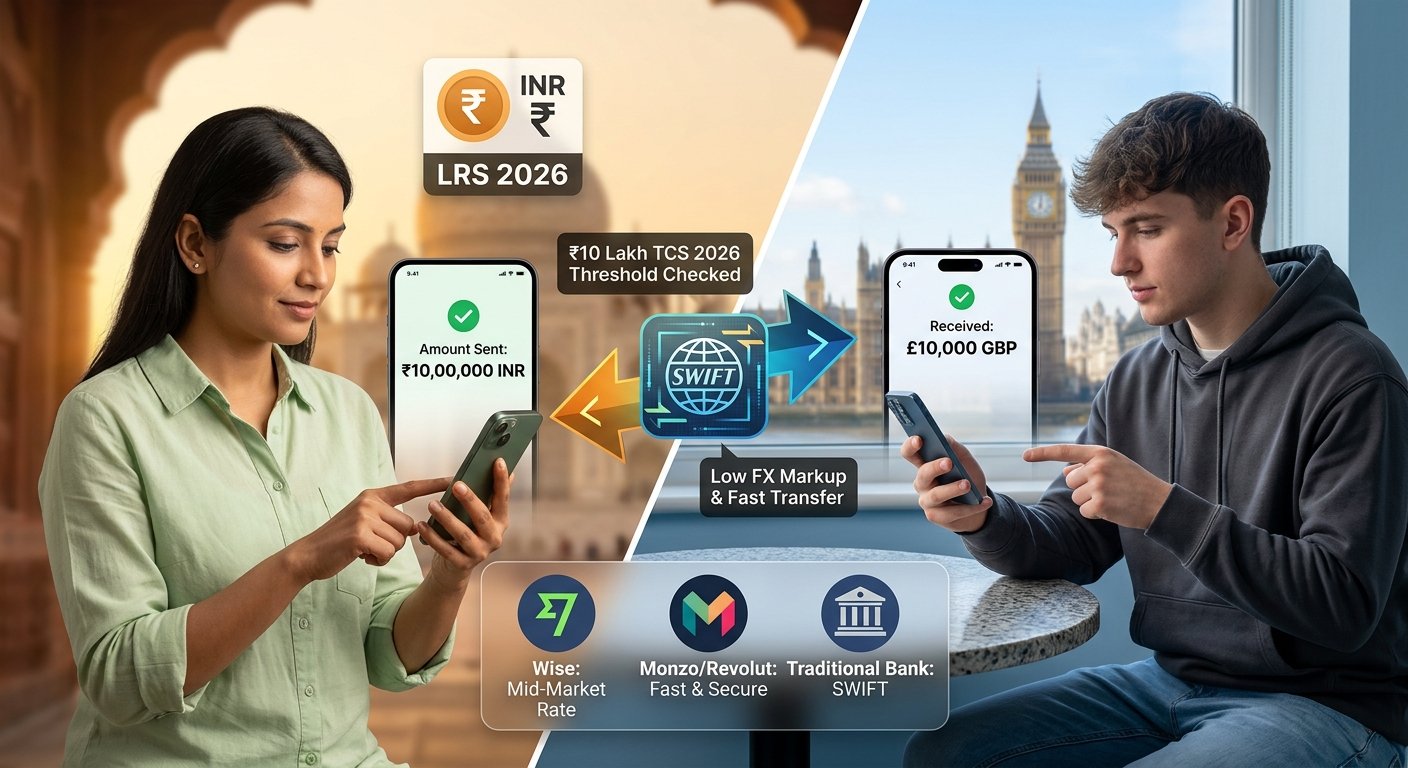
Compare fees, exchange rate markups, speed, and RBI TCS rules for sending money from India to a UK bank account using Wise, Revolut, Monzo, and Traditional Wire Transfers.
When transferring funds from an Indian bank account to a UK bank account—whether for university tuition, rent, living expenses, or family gifts—most people ask the same core question: Which option actually leaves the most money in my UK account?
Navigating cross-border transfers from India involves balancing foreign exchange (FX) markups, fixed wire fees, and Reserve Bank of India (RBI) regulations like the Liberalised Remittance Scheme (LRS) and Tax Collected at Source (TCS).
Below is an objective breakdown of how Wise, Revolut, Monzo, and Traditional Wire Transfers perform on the India–UK remittance corridor, complete with a regularly updated tested fee table.
The Core Dynamic: Inward vs. Outward Remittance Rules
Before comparing platforms, it is important to understand a key structural rule of Indian banking: All money originating from an Indian bank account must leave via an Authorized Dealer (AD Category-I) bank under the RBI’s LRS framework.
- Wise & Monzo: You cannot directly “pull” money out of a standard Indian bank account using a UK Monzo card or UK Wise debit card. Instead, the transfer must be initiated as an outward remittance from India.
- Revolut & Monzo in the UK: Monzo and Revolut function primarily as receiving accounts on the UK end. Monzo partners with Wise natively inside its app for international payments, while Revolut processes inward SWIFT/local payments directly into its multi-currency vaults.
Dated & Tested Fee Table (Q4 2026 Benchmark)
Scenario Tested: Parents in India sending ₹500,000 INR (~£4,500 GBP equivalent) to a UK student/resident bank account.
| Provider / Channel | FX Rate Applied | Transfer / Admin Fee | Estimated TCS (Under ₹10L Threshold) | Total Hidden Markup | Delivery Time |
| Wise (Outward from India) | Mid-Market Rate (Zero Markup) | ~0.45% – 0.65% (Upfront) | 0% (Under ₹10 Lakhs) | Lowest Overall (~0.5%) | 1 – 2 Business Days |
| Revolut (Inward to UK) | Interbank Rate (0% weekday allowance on paid plans) | Free receiving (SWIFT routing fees may apply) | 0% (Handled by sending Indian bank) | Low–Medium (Depends on sending bank’s FX) | 1 – 3 Business Days |
| Monzo (via Wise integration) | Mid-Market Rate | Standard Wise fee | 0% (Under ₹10 Lakhs) | Low (~0.5%) | 1 – 2 Business Days |
| Traditional Indian Bank (SBI / ICICI / HDFC Wire) | Bank Custom Exchange Rate (1.5% – 3% markup) | ₹500 – ₹1,500 + Foreign SWIFT charge (£10–£15) | 0% (Under ₹10 Lakhs) | Highest (2.5% – 4% total loss) | 2 – 5 Business Days |
Quarterly Fee Refresh Note: The RBI’s LRS exemption threshold stands at ₹10 Lakhs per financial year. Remittances below ₹10 Lakhs attract 0% TCS across education, medical, and general maintenance purposes. For amounts exceeding ₹10 Lakhs, TCS applies at 2% for education/medical and 20% for general gifts/investments.
Detailed Platform Breakdown
1. Wise (Best Overall for Transparency & Cost)
Wise operates by using local bank accounts in both India and the UK. Instead of routing funds internationally through multiple intermediate clearing banks, you pay INR to Wise’s local Indian partner, and Wise pays out GBP from its UK account.
- Pros: Uses the live mid-market exchange rate (the rate seen on Google) without hidden markups. All fees are shown upfront before confirming.
- Cons: Not a fully licensed UK bank (operates as an Electronic Money Institution/EMI, meaning no FSCS deposit insurance protection on cash balances).
2. Revolut (Best Multi-Currency Management)
Revolut received its full UK banking license, giving UK account balances FSCS protection up to £120,000. While Revolut is excellent for holding and spending multiple currencies, sending money out of India directly into Revolut requires initiating an international wire from an Indian bank or an authorized forex provider.
- Pros: Instant conversion between 150+ currencies once the funds arrive in the UK.
- Cons: Weekend exchange rate markups (0.5%–1.0%) apply if currency conversions are made outside market hours. Monthly fee-free FX limits apply on standard plans.
3. Monzo (Best Main UK Current Account)
Monzo is a full UK bank with £120,000 FSCS deposit protection. Monzo does not process outward international transfers using its own proprietary engine; instead, it integrates Wise natively within the Monzo app.
- Pros: Highly convenient if Monzo is your primary UK bank. You get your standard UK Sort Code (6 digits) and Account Number (8 digits) to receive incoming transfers directly.
- Cons: Monzo itself cannot process direct outward INR transfers natively without going through Wise or an external provider.
4. Traditional Bank Wire Transfer (SBI, ICICI, HDFC, Axis to Barclays, HSBC, Lloyds)
Traditional wire transfers (Telegraphic Transfers / SWIFT) are handled directly between commercial banks.
- Pros: Handled through familiar net-banking portals; ideal for large university tuition payments sent directly to institutional account numbers.
- Cons: Most expensive method. Traditional banks build a 1.5% to 3.5% margin directly into the exchange rate, on top of fixed processing fees and receiving bank charges on the UK side.
How to Choose the Right Setup
- For General Monthly Expenses & Allowance:Initiate the transfer from India using Wise (or an authorized online forex portal) targeting your Monzo or Revolut account in the UK. This minimizes FX markups while ensuring your money lands in a secure, daily-use UK account.
- For University Tuition Payments:Compare your Indian bank’s official student portal rate against Wise. For very large sums (e.g., £15,000+), specialized forex providers or direct bank SWIFT transfers with negotiated FX margins can sometimes offer competitive rate locks.
- To Avoid Tax Delays:Ensure your parents mark the transaction with the correct RBI Purpose Code (e.g.,
S0305for student maintenance orS0304for tuition fees) to ensure accurate tax classification under the ₹10 Lakh TCS threshold.
Frequently Asked Questions
-
Can I use my Indian debit card on Monzo or Revolut in the UK?
No. You cannot top up a UK Monzo or Revolut account directly using an Indian debit or credit card due to Indian capital control regulations under FEMA. The money must be remitted via bank transfer/LRS channels.
-
Does my UK bank charge a fee to receive funds?
Monzo, Revolut, and Wise do not charge receiving fees for incoming local transfers. However, if money is sent via traditional SWIFT wire to high-street banks (Barclays, HSBC, Lloyds), intermediary routing banks may deduct a £6–£15 handling fee before landing in your account.





Guide to Emergency Tax Code and National Insurance for Indian Students in the UK
Are you an international student or a new arrival from India looking...
Ansar Sk4 Mins read
Practical Senior’s Guide to Freshers in UK
Getting off the plane at Heathrow or Manchester Airport is a surreal...
Ansar Sk3 Mins read

How to Send Money from India to UK Bank Account (2026 Guide)
Can your parents send money from India to your UK bank account?...
Ansar Sk3 Mins read




Leave a comment