





How to Send Money from India to UK Bank Account (2026 Guide)
Can your parents send money from India to your UK bank account?
 Ansar SkOctober 20, 20263 Mins read6
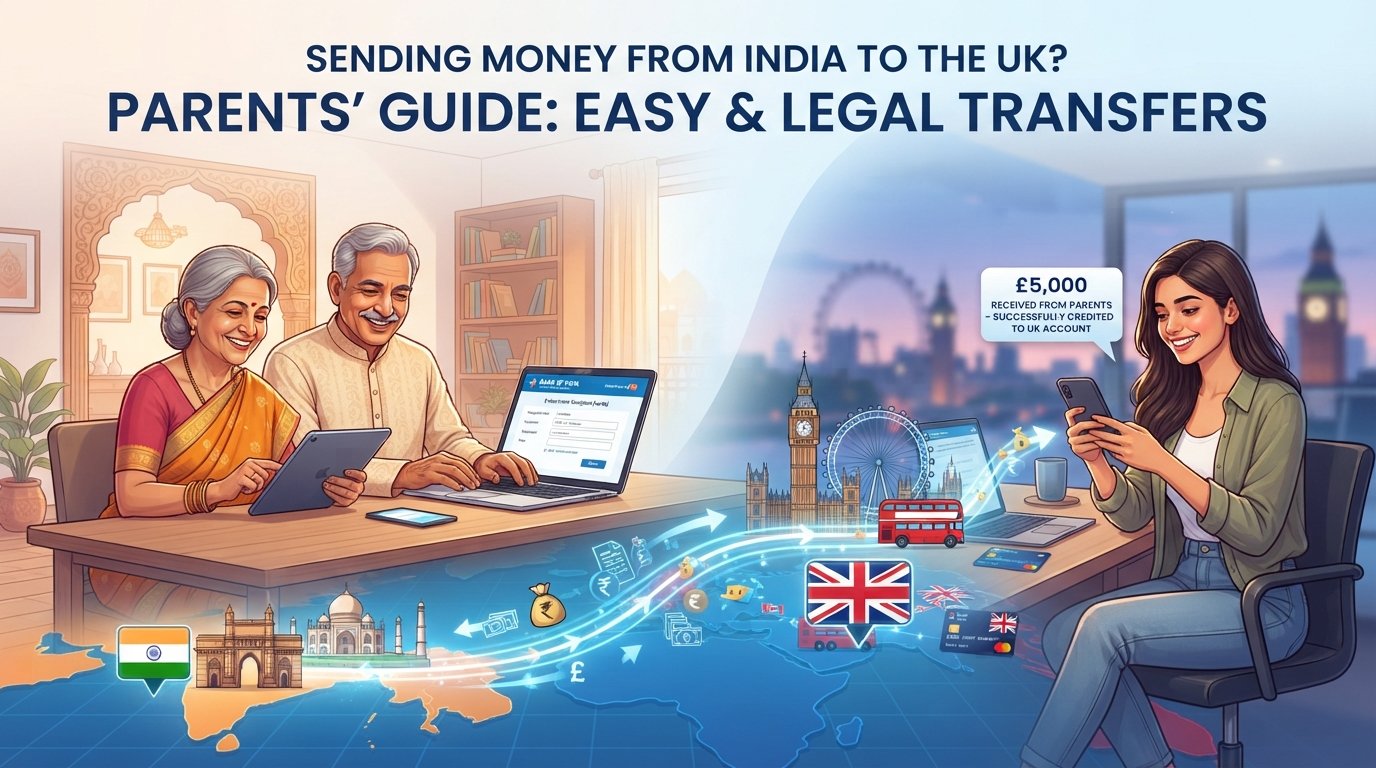
Can your parents send money from India to your UK bank account? Yes. Learn about RBI LRS limits, tax rules (TCS), necessary documents, and the best ways to transfer funds safely.
If you are studying, living, or working in the UK, maintaining your finances across borders is a primary necessity. Whether it’s for tuition fees, monthly living expenses, or a financial gift, yes, your parents can legally transfer money directly from an Indian bank account to your UK bank account.
However, because outward remittances from India are regulated, your parents must follow guidelines set by the Reserve Bank of India (RBI) under the Liberalised Remittance Scheme (LRS).
Here is everything you and your parents need to know about limits, tax implications, required documents, and the best transfer methods.
1. What Are the Rules? (RBI’s LRS Framework)
Under the RBI’s Liberalised Remittance Scheme (LRS), any resident Indian individual can send up to USD $250,000 (or its equivalent in GBP) per financial year (April 1 to March 31).
Permissible Transfer Purposes:
When your parents transfer funds, they must declare a specific Purpose Code required by the RBI. Permissible categories include:
- Gift / Financial Support: Sending money to immediate family members living abroad.
- Education: Paying tuition fees, university accommodation, or student maintenance costs.
- Living Expenses: Monthly living costs for students or residents.
- Medical Treatment: Covering medical expenses incurred overseas.
2. Is There a Tax Implication? (TCS & UK Tax Rules)
In India: Tax Collected at Source (TCS)
Under Indian tax rules, foreign transfers under LRS may attract Tax Collected at Source (TCS) depending on the amount and purpose:
- Education Transfers (Financed via Loan): 0.5% TCS on amounts exceeding ₹7 Lakhs.
- Education Transfers (Self-Funded / Parents): 5% TCS on amounts exceeding ₹7 Lakhs.
- Gift or Personal Maintenance: 20% TCS on amounts exceeding ₹7 Lakhs per financial year.
Note: TCS is not an extra tax/expense. It is an advance tax credited to your parents’ Permanent Account Number (PAN) and can be adjusted or refunded when they file their Income Tax Return (ITR) in India.
In the UK: HMRC Rules
- Gifts from Parents: Money sent by parents as a pure gift is generally non-taxable in the UK.
- Capital Gains / Income: If the money sent represents investment income or salary generated abroad, specific UK tax rules (e.g., non-domiciled status or remittance basis) may apply depending on your residency status.
3. Required Documents & Banking Information
To process the transaction smoothly, your parents will need specific details and documents:
From Your Parents (Sender):
- PAN Card (mandatory for LRS transfers)
- Aadhaar Card or Government Photo ID
- Form A2 & LRS Declaration (provided by the bank or transfer platform to confirm the purpose of remittance)
From You (UK Receiver):
- Full Name (as written on your UK bank account)
- UK Account Number (8 digits) & Sort Code (6 digits)
- IBAN (International Bank Account Number, usually starting with
GB) - SWIFT / BIC Code of your UK bank
- Bank Name and Branch Address
4. Best Ways to Send Money from India to the UK
| Method | Processing Time | Pros | Cons |
| Specialized Online Remittance Platforms | 1–2 business days | Higher exchange rates, lower fixed fees, fully digital | Requires online account setup |
| Indian Commercial Banks (Wire Transfer) | 2–5 business days | Secure, familiar, handled directly via net banking | Higher markup on exchange rates, foreign bank SWIFT charges |
| Authorised Forex Dealers | 1–3 business days | Competitive rates for large education transfers | May require in-person branch visits or extra paperwork |
5. Step-by-Step Action Plan for Your Parents
- Check the Current Threshold: Calculate total remittances made in the current Indian financial year to track the ₹7 Lakh TCS threshold.
- Gather Required Details: Provide your parents with your UK bank’s IBAN, SWIFT code, and account details.
- Select the Platform: Compare total delivery costs (exchange rate markup + transaction fees) across bank net-banking portals and authorized remittance providers.
- Complete Form A2: Select the correct Purpose Code (e.g., “S0305” for travel/living or “S0304” for education fees).
- Initiate Transfer: Process via NEFT/RTGS to the transfer portal or submit directly via online bank transfer.
Frequently Asked Questions (FAQ’s):
How long does a money transfer from India to the UK take?
Most electronic transfers take 1 to 3 business days to hit a UK bank account, depending on bank clearance times and SWIFT processing.
Is there a maximum limit my parents can send in one go?
There is no single-transaction cap, provided the total amount transferred in a financial year remains under USD $250,000 per resident individual.
Will my UK bank charge me to receive the money?
Some UK banks charge an inward international receiving fee (typically £0 to £10), or intermediary SWIFT banks may deduct a small handling fee during routing. Check with your UK bank beforehand.





Guide to Emergency Tax Code and National Insurance for Indian Students in the UK
Are you an international student or a new arrival from India looking...
Ansar Sk4 Mins read
Practical Senior’s Guide to Freshers in UK
Getting off the plane at Heathrow or Manchester Airport is a surreal...
Ansar Sk3 Mins read
Wise vs Revolut vs Monzo vs Bank Transfer: India to UK (2026 Tested)
Compare fees, exchange rate markups, speed, and RBI TCS rules for sending...
Ansar Sk4 Mins read




Leave a comment