





Guide to Emergency Tax Code and National Insurance for Indian Students in the UK
 Ansar SkOctober 21, 20264 Mins read2

Are you an international student or a new arrival from India looking at your very first UK payslip in shock? If your paycheck is significantly lower than you expected, you have likely fallen into the UK Emergency Tax Trap.
This comprehensive SEO guide breaks down exactly why His Majesty’s Revenue and Customs (HMRC) overtaxes fresh starters, how the National Insurance Number (NINo) timeline works, and how to get every single pound of your hard-earned money back into your bank account.
What is an Emergency Tax Code and Why Did It Happen to You?
In the United Kingdom, every resident is entitled to a Personal Allowance. This is the amount of income you can earn each fiscal year (running from April 6th to April 5th of the following year) completely tax-free. The standard tax-free allowance is £12,570.
Normally, employers spread this tax-free threshold evenly across your monthly paychecks. However, when you are a fresh starter arriving from India, HMRC has zero record of your UK financial history. Because you cannot hand your new company a P45 form (the official document from a previous UK employer), their payroll software automatically defaults to a temporary, high-deduction Emergency Tax Code.
How to Spot Emergency Tax on Your Payslip?
Look closely at the “Tax Code” box on your first payslip. If you see any of the following codes, you are actively paying emergency tax:
- BR (Basic Rate): The most punitive code. It slaps a flat 20% deduction on your entire earnings, ignoring your tax-free allowance from the very first pound.
- 1257L M1 (Month 1): Your tax is calculated in a strict vacuum for just that month. If you pull extra shifts, the system assumes you make that massive amount year-round and overtaxes you.
- 1257L W1 (Week 1): The weekly equivalent of the Month 1 non-cumulative trap.
The Ultimate Fresh Starter Timeline: From Landing to Refund
Navigating the UK administrative system can feel overwhelming. Follow this exact timeline to structure your first few months legally and financially:
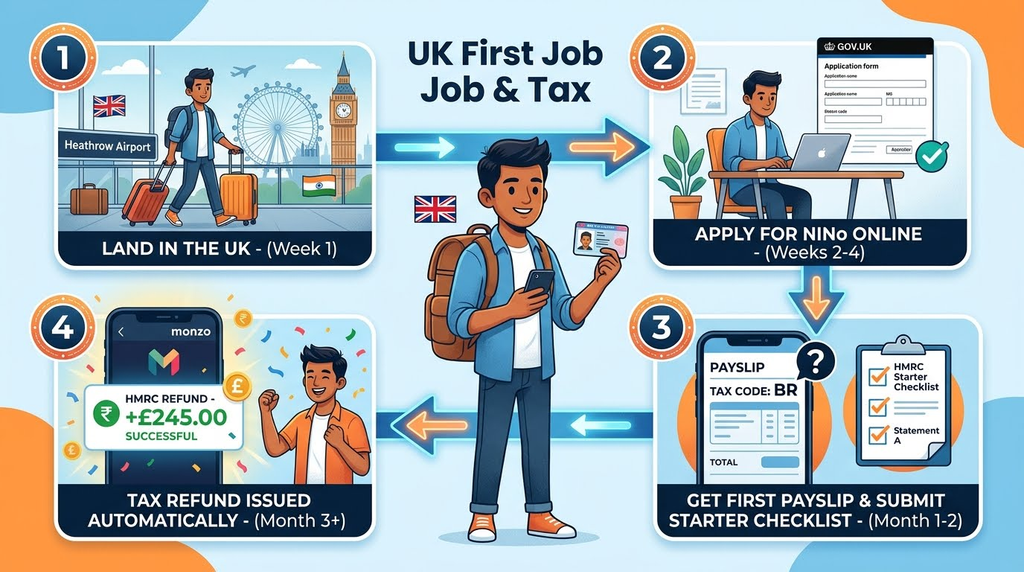
How to Fix Your Emergency Tax Code: Step-by-Step
Do not wait for your HR manager or HMRC to automatically figure out you are being overtaxed. You need to intervene immediately during your first week on the job.
Step 1: Request the HMRC New Starter Checklist
Since you don’t have a P45, you must fill out the digital HMRC New Starter Checklist. Your employer’s payroll team can provide this, or you can access it directly via the official government portal.
Step 2: Select “Statement A”
The form will present you with three crucial history options. As a fresh starter from India with no prior UK income since April 6th, you must tick Statement A.
- Statement A explicitly tells HMRC: “This is my first job since 6 April…”
- Selecting this automatically triggers the system to unlock your pro-rata monthly slice of the £12,570 tax-free allowance, stopping emergency deductions on your next pay cycle.
Step 3: Monitor Your Next Payslip
Once HR processes the form, your tax code will update to the standard, cumulative 1257L.
National Insurance Number (NI No) Guide for New Arrivals
Your National Insurance Number is your unique, lifelong identifier for the UK social security and tax network.
⚠️ The Biggest Myth Debunked
Many international students falsely believe: “I cannot legally sign a work contract or get paid until my National Insurance Number arrives.”This is completely incorrect.
Under official UK employment laws, you can begin working immediately after passing your employer’s standard Right to Work check (using your digital eVisa share code or passport). Your employer will simply use a temporary dummy code on their payroll system until your official number is ready.
How to Apply for Your NI No for Free
Never pay a third-party agency online promising to expedite your application. The process is entirely free through the government.
- Go directly to the official Apply for a National Insurance number on GOV.UK portal.
- Upload clear photos of your passport, your visa vignette, or your Biometric Residence Permit (BRP).
- Your permanent number will arrive via a physical mail letter within 2 to 4 weeks. Hand this code to your employer immediately upon receipt.
How to Claim Your Overpaid Tax Refund
The best part about emergency tax is that the government does not keep your money. You will get every penny back using one of two methods:
Method 1: Automated Payroll Adjustments (Fastest)
If you submit your Starter Checklist quickly and stay with the same employer, HMRC corrects your code mid-employment. On your very next regular payday, your payroll system will calculate the previous overpayment and issue a positive tax adjustment. Your overpaid tax is added directly into your net take-home pay.
Method 2: The Official HMRC Personal Tax App
If you finish a temporary seasonal job or switch employers before your code updates, log into your digital HMRC Personal Tax Account or download the official HMRC App.
- Following the close of the tax year on April 5th, HMRC automatically recalculates your total annual earnings against what you paid.
- A notification will appear stating you have overpaid tax.
- Type in your UK bank account details, and the government will wire your refund directly via BACS within 5 working days.
Comparison: Standard UK Tax Code vs. Emergency Tax Code
| Financial & Administrative Feature | Standard UK Tax Code (e.g., 1257L) | Emergency Tax Code (e.g., BR, M1, W1) |
|---|---|---|
| Tax-Free Threshold Status | Grants you your full pro-rata slice of the £12,570 allowance monthly. | Often calculates your paycheck with a 0% tax-free allowance allocation. |
| Deduction Rates | 20% on any basic-rate income earned above your allowance allowance. | A flat 20% cut on your entire gross earnings from the very first pound (under BR). |
| Primary Trigger | Providing a valid UK P45 form or a processed Starter Checklist. | Starting a new job with no historical UK tax data on file. |
| How to Resolve | No action required; monitored automatically by payroll software. | Complete and submit the digital HMRC New Starter Checklist immediately to HR. |
To ensure your first UK paycheck arrives smoothly without errors:
- Do you know if your student visa places a 10-hour or 20-hour restriction on your weekly part-time work limits?
- Would you like me to map out how National Insurance contribution thresholds are calculated separately from Income Tax?




Practical Senior’s Guide to Freshers in UK
Getting off the plane at Heathrow or Manchester Airport is a surreal...
Ansar Sk3 Mins read
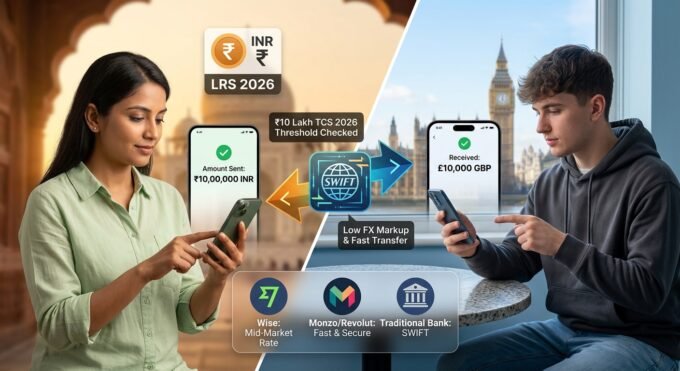
Wise vs Revolut vs Monzo vs Bank Transfer: India to UK (2026 Tested)
Compare fees, exchange rate markups, speed, and RBI TCS rules for sending...
Ansar Sk4 Mins read
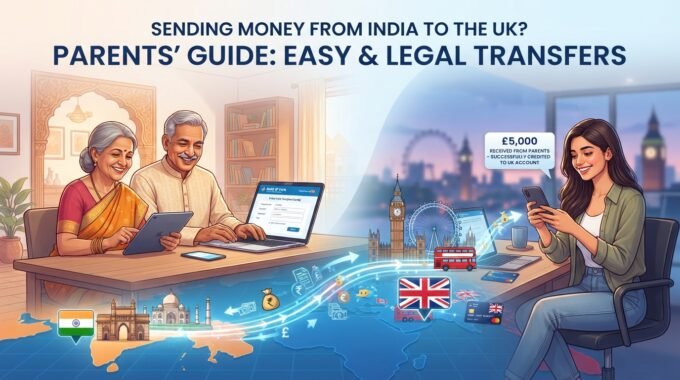
How to Send Money from India to UK Bank Account (2026 Guide)
Can your parents send money from India to your UK bank account?...
Ansar Sk3 Mins read




Leave a comment