





Getting off the plane at Heathrow or Manchester Airport is a surreal feeling. You are surrounded by massive suitcases, holding a folder full of stamped documents, and feeling a mix of pure excitement and absolute panic.
As an Indian student who sat on that exact same flight a few years ago, I know exactly what is going through your head. The biggest shock doesn’t come from the cold weather—it comes when you open your banking app and see how quickly your money disappears in your first month.
Your first 30 days will be your most expensive month in the UK because you are starting your life from scratch. To make sure you don’t burn through your hard-earned rupees, here is the honest, unfiltered financial guide I wish someone had handed me when I first landed.
The “Day 1” Hidden Cost: The 5-Week Rent Deposit
Back home, renting a flat involves a negotiation with a local landlord. In the UK, the system is strictly regulated, especially for international students.
If you are renting private accommodation (outside of university-managed halls), landlords or student housing companies legally require a tenancy deposit before they hand over your keys. By UK law, this deposit is capped at a maximum of 5 weeks’ worth of rent.
The Real Math (Outside London vs. Inside London)
Let’s look at what actually leaves your bank account before you even sleep in your new bed.
- Outside London (e.g., Manchester, Birmingham, Leeds):
- Average monthly rent: £550 (approx. ₹60,500) [1]
- Upfront 5-week deposit: £635 (approx. ₹69,850)
- Total Day 1 Housing Cost: £1,185 (approx. ₹1,30,350)
- Inside London:
- Average monthly rent: £900 (approx. ₹99,000) [1]
- Upfront 5-week deposit: £1,038 (approx. ₹1,14,180)
- Total Day 1 Housing Cost: £1,938 (approx. ₹2,13,180)
Senior Pro-Tip: Make sure your landlord places your deposit into a government-backed Tenancy Deposit Scheme (TDS). They are legally required to send you a certificate proving this within 30 days. If they don’t, it’s a massive red flag.
The First Weekend: Setting Up Your Room & Kitchen
You will arrive with clothes and spices, but you won’t have a duvet, pillows, or a frying pan. Many Indian students make the mistake of walking into high-street department stores like John Lewis or Marks & Spencer for these items. Doing that will wipe out your budget immediately.
Instead, drag your flatmates to budget havens like Primark Home, IKEA, Wilko, or Dunelm.
What a Realistic Setup Shopping List Looks Like:
- Warm Duvet & 2 Pillows: £20 – £25 (approx. ₹2,200 – ₹2,750)
- Bedding Sheets & Pillowcases: £12 (approx. ₹1,320)
- One Frying Pan & One Pot (Induction friendly): £15 (approx. ₹1,650)
- Plates, Spoons, & Mugs (Pack of 4): £10 (approx. ₹1,100)
- Total Setup Expense: ~£62 (approx. ₹6,820)
The Grocery Shock: Feeding Yourself the Desi Way
You do not need to survive on bland food or frozen pizzas. The UK has a massive South Asian diaspora, and you can find Indian groceries almost anywhere.
For your weekly essentials (milk, eggs, bread, vegetables), stick to Aldi, Lidl, or Asda. They are significantly cheaper than Sainsbury’s or Tesco.
For your comfort food—like a 10kg bag of Ashirvaad Atta, Tilda Basmati rice, MDH Masalas, and local dals—head to the nearest local international supermarket or “Desi corner shop.” Cities like Leicester, Birmingham, London, and Manchester have entire streets dedicated to them.
- Average Weekly Food Bill (Cooking at home): £30 to £40 per week (approx. ₹3,300 – ₹4,400).
- Eating Out/Takeaway: £10 to £15 per meal (approx. ₹1,100 – ₹1,650). Cook at home to save your wallet!
Phones and Commutes: The Setup Details
1. The Mobile SIM Card
Do not keep using your Indian international roaming pack. Pick up a rolling monthly contract SIM card. Brands like giffgaff, VOXI, and Smarty run on major networks but charge a fraction of the price. You can get 30GB to 60GB of data, plus unlimited UK calls, for just £10 to £15 a month (approx. ₹1,100 – ₹1,650). No long-term contracts required.
2. Trains and Buses
If you need to travel by train between UK cities or commute to campus, download the Trainline app immediately. Your very first purchase should be a 16-25 Railcard. It costs £30 for the whole year, but it gives you a 33% discount on every single train journey you take in the country. It pays for itself within two or three trips.
The Ultimate First-Month Budget Blueprint
To help you visualize your exact expenses, here is a realistic look at your first 30 days compared to your second month onwards (assuming you live outside of London).
| Expense Category | Month 1 (Setup + Rent) | Month 2 Onwards (Steady State) |
|---|---|---|
| First Month’s Rent | £550 (₹60,500) | £550 (₹60,500) |
| Tenancy Deposit (5 Weeks) | £635 (₹69,850) | £0 (One-time payment) |
| Room & Kitchen Hardware Setup | £62 (₹6,820) | £0 (One-time payment) |
| Monthly Groceries & Food | £140 (₹15,400) | £140 (₹15,400) |
| Mobile Data Plan | £12 (₹1,320) | £12 (₹1,320) |
| Local Travel & 16-25 Railcard | £65 (₹7,150) | £35 (₹3,850) |
| TOTALS | £1,464 (₹1,61,040) | £737 (₹81,070) |
Summary Words of Wisdom from a Senior
- Don’t constantly multiply by 110 in your head. Yes, convert your money initially to understand the value, but don’t let constant currency conversion stress you out from buying fresh fruit or a warm winter jacket. Budget in Pounds once you arrive.
- Open a digital bank account on Day 1. Traditional UK banks can take weeks to book an appointment and verify your student status letter. Apps like Revolut or Monzo allow you to set up a UK account on your phone in 10 minutes using your BRP (Biometric Residence Permit) and passport.
- The Visa Rules are Real: The UKVI requires you to show maintenance funds of £1,171/month (outside London) or £1,529/month (inside London). Treat those numbers as an accurate indicator of what a comfortable life costs.
Welcome to the UK! It is a beautiful country, and once you get past the initial financial hurdles of the first four weeks, you will find your rhythm and make memories that last a lifetime.






Guide to Emergency Tax Code and National Insurance for Indian Students in the UK
Are you an international student or a new arrival from India looking...
 Ansar Sk4 Mins read
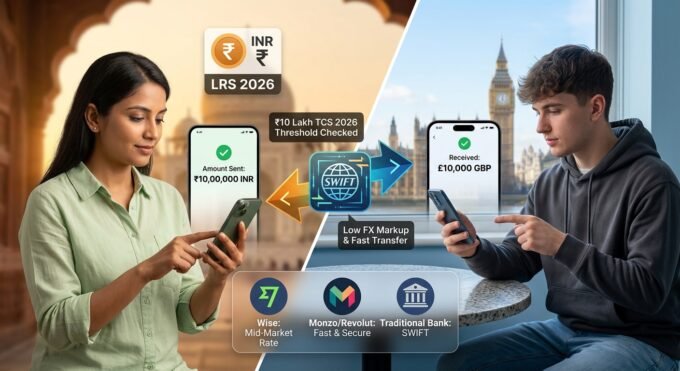
Wise vs Revolut vs Monzo vs Bank Transfer: India to UK (2026 Tested)
Compare fees, exchange rate markups, speed, and RBI TCS rules for sending...
Ansar Sk4 Mins read
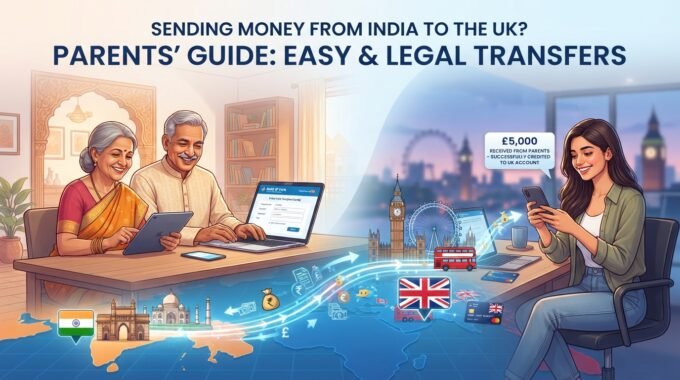
How to Send Money from India to UK Bank Account (2026 Guide)
Can your parents send money from India to your UK bank account?...
Ansar Sk3 Mins read




Leave a comment